The New York Cybersecurity Regulation
Geremia Adamo Jr.
The regulation impacts "Covered Entities," who include all financial institutions, including banks, money managers, and insurance companies among others that conduct business within New York.
These standards require designing and maintaining a cybersecurity program to protect the confidentiality, integrity, and availability of the Information Systems and any Nonpublic Information belonging to consumers. The Regulation mandates a number of additional requirements.
In late 2023, the NYDFS enacted an amendment to the regulation, which mandated a host of new requirements for Covered Entities.
Similar Standards
National Institute of Standards and Technology (NIST)

The NIST Cybersecurity Framework, considered the gold standard for cybersecurity in the US. The Framework provides a set of cyber activities, outcomes, and information common across different internet sectors.NIST provides five elements, or core functions of the framework: Identify; Protect; Detect; Respond; and Recover
NIST Cybersecurity Framework
European Union General Data Protection Regulation (GDPR)
 The General Data Protection Regulation (GDPR) is a legal framework that sets guidelines for the collection and processing of personal information of the European Union (EU) data subjects. The GDPR protects the rights and freedoms of personal information in the attempts to prevent data breaches from occurring.The GDPR also imposes fines on entities that do not maintain compliance with the mandates.GDPR went into effect on May 25, 2018.
General Data Protection Regulation
Federal Trade Commission
 The FTC's Standards for Safeguarding Customer Information Rule ('Safeguards Rule') was created to safeguard the security of customer information.
The Rule was first enacted in 2003, but subsequently amended in 2021 to accomodate advancements in technology.
The Safeguards Rule covers 'financial institutions,' which are entities that are engaged in an activity that is financial in nature or incidental to such financial activities.
The Rule requires covered financial institutions to develop, implement, and maintain an information security.
Click here to learn more about the FTC Safeguards Rule
Canadian Personal Information Protection and Electronic Documents Act (PIPEDA)
 Canada's Personal Information Protection and Electronic Document's Act (PIPEDA) applies tocorporations in Canada that "collect, use or disclose personal information in the course of a commercial activity."PIPEDA defines a commercial activirty as "any particular transaction, act, or conduct, or any regular course of conduct that is of a commercial character, including the selling, bartering, or leasing of donor, membership, or other fundraising lists."
Click here to learn more about PIPEDA
EU Digital Operational Resilience Act (DORA)

DORA, enacted in 2022, is an EU regulation, similar to 23 NYCRR 500, that impacts financial service institutions. DORA focuses specifically on cybersecurity protections for these institutions. Entities covered under DORA have until January 17, 2025 to comply before enforcement begins.
DORA requires financial entities to address cybersecurity complaince for Risk management and governance, incident response and reporting, digital operational resilience testing, and third-party riskmanagement.
Interestingly, similar to 23 NYCRR 500, DORA's guidelines financial entities individually, based on their own existing guidelines. DORA focuses on establishing a "universal framework for managing and mitigating ICT risk" by removing gaps between EU nations.
Also similar to 23 NYCRR 500, Small financial institutions are not held to the same standards as major financial institutions.
Click here to learn more about DORA
The Regulation
Who does it impact? 500.1(g)
Click here to go to the Regulation
Required Cybersecurity Program: 500.2
- identify and assess internal and external cybersecurity risks that may threaten the security or integrity of nonpublic information stored on the covered entity's information systems;
- use defensive infrastructure and the implementation of policies and procedures to protect the covered entity's information systems, and the nonpublic information stored on those information systems, from unauthorized access, use or other malicious acts;
- detect cybersecurity events;
- respond to identified or detected cybersecurity events to mitigate any negative effects;
- recover from cybersecurity events and restore normal operations and services; and
- fulfill applicable regulatory reporting obligations.
Required Cybersecurity Policy: 500.3
Chief Information Security Officer (CISO): 500.4
As per the regulation, a CISO must be "a qualified individual responsible for overseeing and implementing a covered entity's cybersecurity program and enforcing its cybesecurity policy."
Vulnerability Management: 500.5
- Ensure that covered entities conduct penetration testing and automated scans of information systems
- Promptly learn of new security vulnerabilities by having a monitoring process in place
- TImely remediate vulnerabilities, prioritizing them based on risk their risk
Audit Trail: 500.6
1) are able to reconstruct financial transactions to comply with the regular operations and obligations of the company; and
2) include audit trails that can detect and respond to cybersecurity events that have a reasonable likelihood of materially harming the normal operations
In addition, subsection 1 records are required to be kept for at least 5 years, and subsection 2 records are required to be kept for at least 3 years
Access Privileges and Management: 500.7
These access controls must, among others, limit access to systems with nonpublic information as well as only permit access to systems on a need-to basis.
Further, these access controls must be periodically review, at least annually to keep them up to date.
Periodic Risk Assessment 500.9
Risk Assessments are required to include
1) criteria to evaluate and categorize identified cybersecurity risks or threats facing the covered entity. See NIST CVSS
2) criteria for assessing the Confidentiality, Integrity, Security, and Availability of the Covered Entity's information systems and nonpublic information. See CIA Triad
3) Requirements describing how identified risks will be mitigated or accepted based on the risk assessment and how the cybersecurity program will addres the risks
What else should I know?
Click here to learn more about CRPTO
Protection of Information
Protected Information: 500.1(k)
Various forms of information are protected under the Cybersecurity Regulation.
Learn More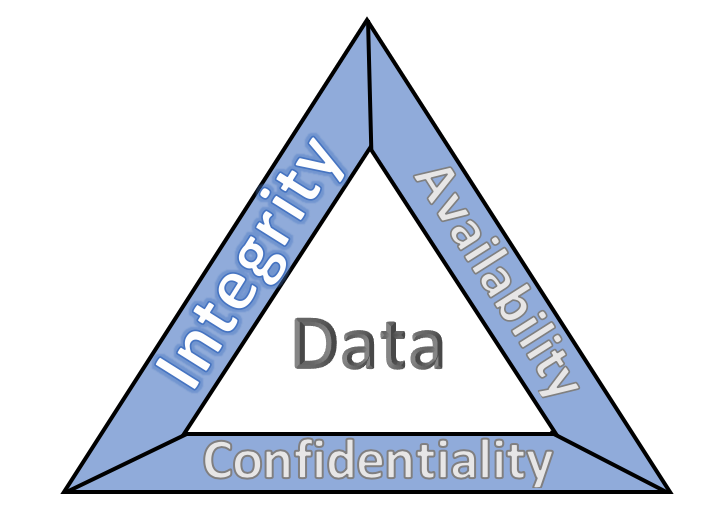
CIA Triad
The CIA Triad represents the three pillars of information security: confidentiality, integrity, and availability The triad is a benchmark model for information securrity programs as each attribute represents an important aspect of information security.
Learn More
Confidentiality: NIST SP 800-122
The term confidentiality means preserving authorized restrictions on access and disclosure, including means for protecting personal privacy and proprietary information.
Learn More
Integrity: NIST SP 800-59
Integrity means guarding against improper information modification or destruction. and includes ensuring information authenticity
Learn More
Availability: NIST SP 800-137
Availability means ensuring timely and reliable access to and use of information
Learn MoreIndustry Guidance & Letters
Self Service Password Reset
First American Financial & Email Vigilance
Guidance to Virtual Currency Entities
Citrix Bleed Vulnerability
This vulnerability allowed cyber actors to take control of affected systems, leading to session hijacking and targeted attacks. Citrix advises immediate installation of recommended builds and termination of active sessions.
Another vulnerability, CVE-2023-4967, has been identified in customer-managed instances of Citrix NetScaler ADC and Gateway. DFS urged regulated entities to assess the risk to their organization and take mitigation measures promptly. Incidents meeting the criteria of 23 NYCRR Section 500.17(a) must be reported via the secure DFS Portal within 72 hours. Additionally, cyber extortion payments must be reported within 24 hours from December 1, 2023, with a description of the rationale provided within 30 days.
MOVEit Transfer Vulnerability
According to Progress’s website, a SQL injection vulnerability had been found in the MOVEit Transfer web application that could allow an un-authenticated attacker to gain unauthorized access to MOVEit Transfer's database. This vulnerability could lead to escalated privileges and potential unauthorized access to the environment. If you were a MOVEit Transfer customer, Progress recommended taking immediate action, including the mitigation measures listed on their website and patching affected versions. All regulated entities were urged to promptly assess risk to their organization, customers, consumers, and third-party service providers based upon the evolving information and take action to mitigate risk.
Regulated entities must report cybersecurity events that met the criteria of 23 NYCRR Section 500.17(a) as promptly as possible and within 72 hours at the latest via the secure DFS Portal, which could be accessed from DFS’s Cybersecurity Resource Center. DFS considered evidence of unauthorized access to information systems, such as webshell installation, even if there had been no malware deployed or data exfiltrated, a reportable Cybersecurity Event pursuant to 23 NYCRR Section 500.17(a)(2).
Log4j Vulnerability
Guidance on Multi-Factor Authentication
MFA weaknesses have consistently been exploited in cyber incidents, with gaps often found in its implementation or configuration. These gaps have led to consequences, impacting millions of consumers. DFS has been actively enforcing MFA requirements, resolving enforcement actions against companies failing to implement it effectively.
he Cybersecurity Regulation mandates MFA for remote access, emphasizing its necessity in managing unauthorized access risks. Despite exemptions for small businesses, the increase in cybercrime has made MFA indispensable for all entities.
Common MFA problems include legacy systems lacking MFA support, insufficient coverage for key applications, and poor management of exceptions. DFS recommends using MFA for privileged accounts and being cautious of different MFA methods' vulnerabilities.
For small businesses, lacking MFA has made them prime targets for cybercriminals. DFS recommends implementing MFA, offering resources like the Cybersecurity Toolkit for Small Business to facilitate the process.
Adoption of an Affiliate's Cybersecurity Program
Ransomware Guidance
DFS emphasized the imperative for institutions to develop comprehensive incident response plans and maintain segregated backups as crucial preparatory measures against potential ransomware incidents. Moreover, DFS highlighted the need for collaborative efforts within the industry to address the evolving ransomware landscape effectively. By adhering to these guidelines and fostering a proactive cybersecurity posture, financial entities could fortify their defenses and minimize the risk of falling victim to ransomware attacks, thereby safeguarding both their operations and the broader financial ecosystem.
Microsoft Reports Exploitation of Four Vulnerabilities in Microsoft Exchange Server
In recent days, thousands of organizations were compromised via zero-day vulnerabilities in Microsoft Exchange Server, despite patches being made available by Microsoft on March 2, 2021. The Department of Financial Services (DFS) urgently advised all regulated entities with vulnerable Microsoft Exchange services to take immediate action by either patching or disconnecting vulnerable servers and utilizing Microsoft's tools to address any compromise resulting from these vulnerabilities. Additionally, the U.S. Department of Homeland Security Cybersecurity & Infrastructure Security Agency (CISA) issued guidance on searching for compromises related to these vulnerabilities.
Microsoft had reported four vulnerabilities affecting on-premises versions of Microsoft Exchange Server, including CVE-2021-26855, CVE-2021-26857, CVE-2021-26858, and CVE-2021-27065, which were actively exploited before the patches were released. CISA recommended immediate patching and advised on preserving forensics of cyber events, highlighting the deployment of web shells by threat actors for persistent network access. Regulated entities were urged to assess the risk to their systems and consumers, track developments related to the compromise, and promptly report cybersecurity events as required by regulation.
Cybersecurity Incidents and Events
Since the original 2017 version of the Cybersecurity Regulation, Covered Entities were required to notify the DFS of any cybersecurity event. See 23 NYCRR 500.1(f), (g). In the most recent amendment to 23 NYCRR 500, Covered Entities are required to notify NYDFS of a qualifying "cybersecurity incident." See 23 NYCRR 500.1(f), (g).
Cybersecurity Event: any act or attempt, successful or unsuccessful, to gain unauthorized access to, disrupt or misuse an Information System or information stored on such Information System
Cybersecurity Incident: a cybersecurity event that has occurred at the covered entity, its affiliates, or a third-party service provider that:
1) impacts the covered entity and requires the convered entity to notify any government body, self-regulatory agency or any other supervisory body;
2) has a reasonable likelihood of materially harming any material part of the normal operation(s) of the covered entity; or
3) results in the deployment of ransomware within a material part of the covered entity's information systems.
WHY is this important?
The original cybersecurity event definition generally covered malicious attacks on confidentiality, integrity, and availability, it mandates a continuous notification scheme to DFS.
In the recent amendments, cybersecurity incidents do not have to be situations where there was a malicious actor; but rather any flaw found within a Covered Entity's systems that impact the Entity, or have a reasonable likelihood of harming the Entity must not be reported.
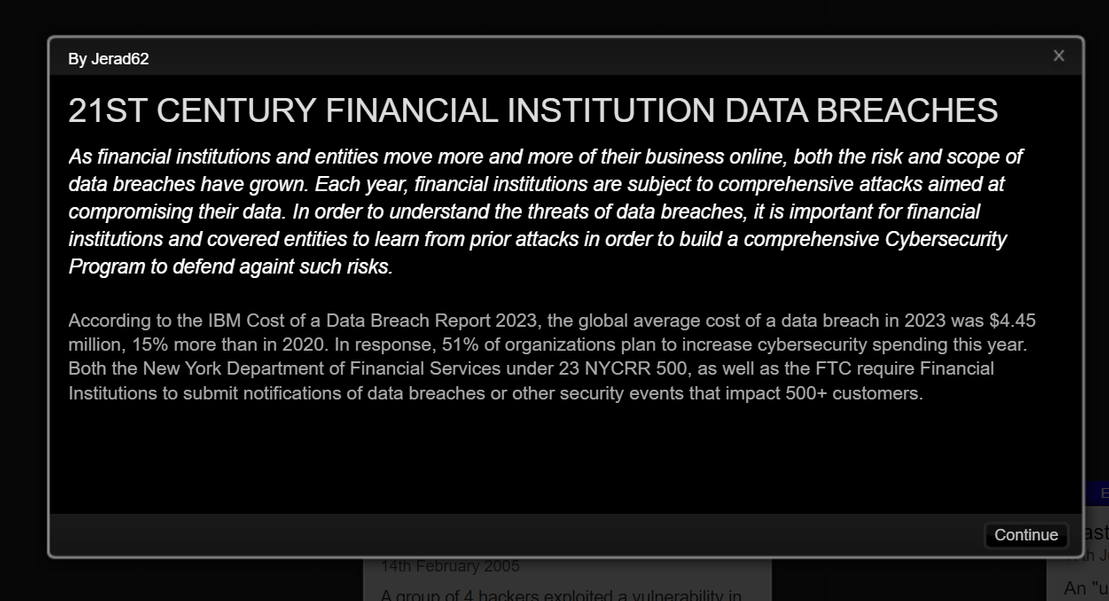
US Financial Institution Cyber Incidents
Annual Cybersecurity Certification
When is the Deadline? 500.17
In addition, Covered entities must by April 15, also submit to NYDFS either:
What is Included in the Notice of Compliance with Part 500?
(b) Annually each Covered Entity shall submit to the superintendent a written statement covering the prior calendar year. This statement shall be submitted by April 15th in such form set forth as Appendix A of this Title, certifying that the Covered Entity is in compliance with the requirements set forth in this Part. Each Covered Entity shall maintain for examination by the Department all records, schedules and data supporting this certificate for a period of five years. To the extent a Covered Entity has identified areas, systems or processes that require material improvement, updating or redesign, the Covered Entity shall document the identification and the remedial efforts planned and underway to address such areas, systems or processes. Such documentation must be available for inspection by the superintendent.
What does my Company's Cybersecurity Program need?
1. Develop and Implement policies and procedures for monitoring and assessing cybersecurity risks
2. Regularly test and update the effectiveness of the cybersecurity program
3. Maintain an inventory of information systems and data
4. Classify the data inventory according to its level of sensitivity
5. Develop and implement policies and procedures for incident response
6. Conduct periodic cybersecurity training for all employees
7. Conuct periodic vulnerability assessments and penetration testing
8. Use defensive infrastructure to protect from unauthorized access, use or malicious acts.
What should YOU do?
Determine if you are a class A company
Prepare to comply with new reporting mandates
Revise your cybersecurity program
Are you a Class A Company? 500.1(d)
- over 2,000 employees averaged over the last two fiscal years, including employees of both the covered entity and all of its affiliates no matter where located; or
- over $1,000,000,000 in gross annual revenue in each of the last two fiscal years from all business operations of the covered entity and all of its affiliates no matter where located.
In addition, Appendix B provides a form for a "Notice of Exemption"; and enables a Covered Entity to provide notice that they qualify for one of the enumerated exceptions.
Enforcement
Who Enforces the Regulation? 500.20(a)
Violations: 500.20(b)
- The commission of any act prohibited under 23 NYCRR 500
- Failure to fulfil any obligation required under 23 NYCRR 500
- Failure to secure or prevent unauthorized access
- Material failure to comply for any 24-hour period
Violation Factors Considered: 500.20(c)
- the extent to which the covered entity has cooperated with the superintendent in the investigation of such acts
- the good faith of the entity
- whether the violations resulted from conduct that was unintentional or inadvertent, reckless or intentional and deliberate
- whether the violation was a result of failure to remedy previous examination matters requiring attention, or failing to adhere to any disciplinary letter, letter of instructions or similar
- any history of prior violations
- whether the violation involved an isolated incident, repeat violations, systemic violations or a pattern of violations
- whether the covered entity provided false or misleading information
- the extent of harm to consumers
- whether required, accurate and timely disclosures were made to affected consumers
- the gravity of the violations
- the number of violations and the length of time over which they occurred
- the extent, if any, to which the senior governing body participated therein
- any penalty or sanction imposed by any other regulatory agency
- the financial resources, net worth and annual business volume of the covered entity and its affiliates
- the extent to which the relevant policies and procedures of the company are consistent with nationally recognized cybersecurity frameworks, such as NIST
- such other matters as justice and the public interest require.
